

A voicemail can capture a number without giving a worried homeowner a reason to wait. Build an after-hours response workflow that captures the problem, checks urgency and makes the next step clear.
Last reviewed: October 14, 2026
At 7:42 p.m., a homeowner finds water spreading beneath the kitchen sink and calls your plumbing company. Your office closed at five. Voicemail answers; they call another plumber. Your team may return the call tomorrow, after the job is gone.
Answer: Capture after-hours plumbing leads with an AI receptionist that collects essential details, routes urgency and explains the next step. Treat five minutes as a response target—not a repair or dispatch promise.
You’ll learn where leads leak, what to automate, when a person must take over and how to implement and measure a small after-hours workflow.
A missed call leaves the customer making the next move
Closing the office does not stop people from finding your business through Google, Bing, your website or a referral. It changes what happens after they decide to contact you.
A caller with an active leak needs more than confirmation that your mailbox works. They need to know whether you serve their address, whether someone is available and what happens next.
Without those answers, continuing down the search results is a reasonable choice. Even a routine inquiry can move elsewhere when another company provides a clearer next step.
The problem is an incomplete response, not just an unanswered phone. A recorded message captures sound. A useful intake process captures a request and assigns responsibility for it.
One evening call reveals the handoff gap
Illustrative scenario—not a customer case study: A homeowner calls a plumbing business at 7:42 p.m. about water pooling under a sink. The owner is finishing a job, the dispatcher is off duty and voicemail says someone will call back.
The homeowner leaves a name but forgets the address. At 8:20 p.m., the owner checks the message, returns the call and gets no answer. The next morning, office staff try again without knowing that the owner already called.
Three failures occurred: nobody established urgency, nobody owned the next action and two people spent time chasing the same incomplete record. Whether or not another plumber won the job, this workflow created avoidable uncertainty and rework.

Now change only the intake. An AI receptionist asks whether water is still flowing, collects the service address and callback number, and checks the approved coverage rules. It alerts the scheduled on-call person and tells the customer whether a callback is pending or no overnight attendance is available.
That does not guarantee a booking. It gives both sides usable information.
The root cause is missing ownership after closing
An AI receptionist is a voice or messaging system that follows business rules to answer inquiries, collect information and route requests. It is not a licensed plumber, an emergency service or proof that a technician is available.
Many businesses already have pieces of a response system: voicemail, call forwarding, website forms and a booking calendar. The failure happens between those pieces.
A form notification sent to an unattended inbox is not a handoff. Neither is a text sent to every technician with no assigned recipient.
Use this recommended Capture–Classify–Commit–Confirm framework:
- Capture: Record enough information to act.
- Classify: Apply approved urgency and coverage rules.
- Commit: Assign the next action to a named person or queue.
- Confirm: Tell the customer what will happen, without overstating availability.
The missing step is often “commit.” Someone must own the request after the technology collects it.
The cost includes wasted time, not just lost jobs
After-hours response gaps affect several parts of the business:
- Acquisition efficiency: A paid or organic inquiry may go unused because nobody completes intake.
- Dispatch quality: Missing location and urgency details make prioritization harder.
- Office workload: Staff reconstruct conversations and repeat calls the next morning.
- Customer confidence: Vague promises make it harder to decide whether to wait.
Revenue impact depends on what happened next. Do not label every missed call “lost revenue.” Some are duplicates, outside your service area or requests you cannot fulfill.
Start with qualified inquiries that did not receive a usable response. Then check whether they booked, declined, went elsewhere or remain unknown. If estimating financial impact, use your own completed-job contribution margin and verified conversion data—not the face value of every inquiry.
More notifications cannot replace a response process
Call forwarding helps only when the recipient can answer. Sending every call to the owner can move the bottleneck from the office to a person who is driving or working.
A generic “we received your message” text acknowledges contact but does not establish urgency or ownership. An open booking calendar can create a different problem if it offers appointments that do not match service coverage or technician availability.
An AI receptionist also fails when allowed to improvise. It should not diagnose plumbing faults, quote unapproved prices, promise arrival times or imply that a technician has been dispatched.
Decision rule: Use automated intake when your coverage rules and handoff responsibilities are clear. If they are not, define them before connecting another tool.
Start with one channel and a five-minute response target
The five-minute fix is a response-window design, not a claim that setup takes five minutes. Begin with after-hours phone calls rather than changing every customer channel at once.
Collect only the details needed for the next action
Recommended intake fields are name, callback number, service address, brief problem description, whether the issue is ongoing and permission for any proposed text follow-up.
Have the system identify itself as an automated receptionist. Confirm critical details, especially the callback number and address. Avoid payment information and unnecessary personal details. Review recording, messaging consent, retention and vendor access requirements before launch; do not enable recording by default.
Route urgency using approved rules
Use three practical routes:
- Potentially urgent plumbing request: Examples include continuing water escape or sewage entering an occupied area. Alert the on-call person if coverage exists; human review determines attendance.
- Routine request: Capture the issue and offer only verified booking options or a clearly stated office-hours callback.
- Immediate danger or outside scope: Do not troubleshoot. Direct callers reporting immediate danger to appropriate local emergency services and state the limits of your plumbing response.
These are intake categories, not diagnoses. Unclear answers, distressed callers and requests outside the script should go to human review when available.
Separate automation from human authority
Automation can collect details, apply rules, notify staff and provide approved status messages.
A human handoff transfers responsibility to a person who accepts the request. That person decides whether to attend, confirms any price or arrival estimate and handles exceptions.
Escalation is the fallback when the first responsible person does not accept within your chosen window, or when the request exceeds the system’s authority. Route to a designated backup—not an endless group notification.
If nobody is available, tell the customer plainly. Never say “someone is on the way” unless dispatch is confirmed.
Test the minimum setup before going live
Recommended implementation checklist:
- Set actual hours, service boundaries and supported job types.
- Name the on-call owner and backup for each shift.
- Approve intake questions, urgency rules and prohibited promises.
- Connect one shared request record that staff can update.
- Set acceptance timers and an unavailable-staff fallback.
- Test a routine call, active leak, unclear address and failed transfer.
- Verify next-morning ownership for every unresolved request.
Measure the response the customer actually receives
Use this illustrative five-minute workflow when an urgent inquiry arrives during a staffed on-call period. Timing is a recommended operating target, not a guaranteed result.
- Minute 0–1: Answer, identify the automated receptionist and begin intake.
- Minutes 1–3: Confirm contact details, location, issue and urgency route.
- Minutes 3–4: Send a concise intake summary to the designated on-call person and request acceptance.
- By minute 5: Give the customer a truthful next-step update. If acceptance is missing, activate the approved backup or unavailable-service message.
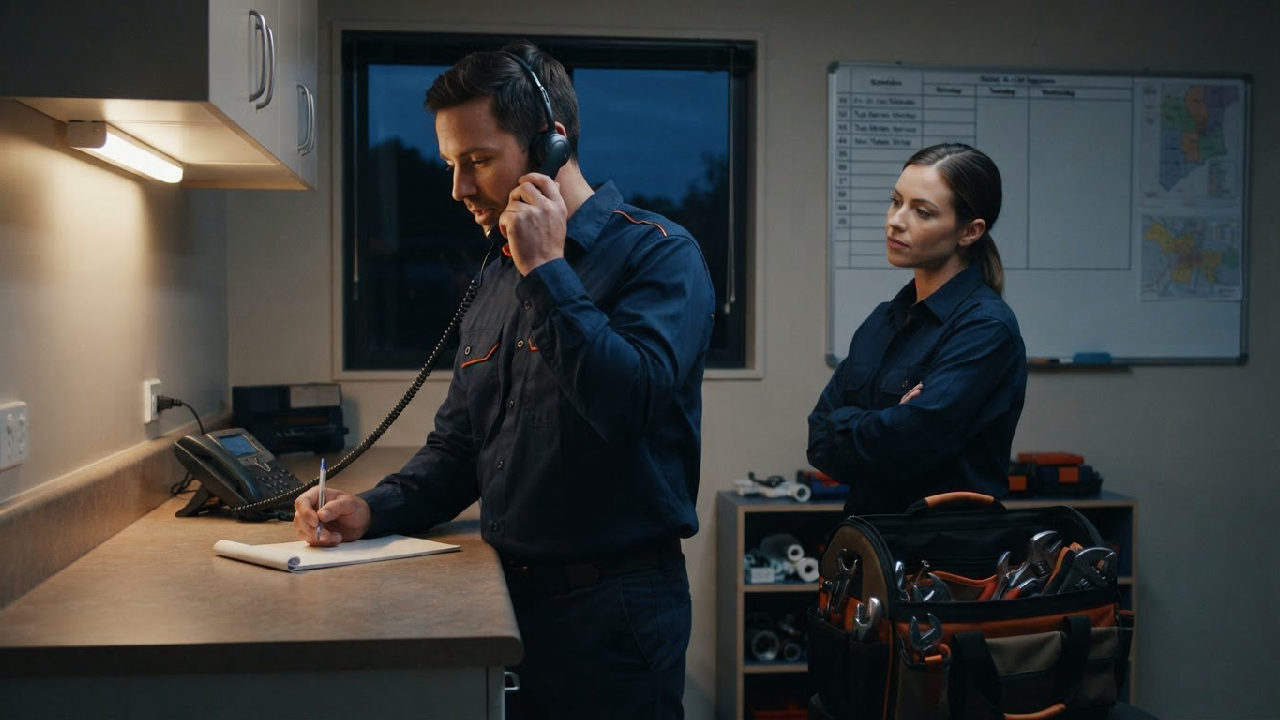
A longer conversation should not be cut short to satisfy the timer. Track time to first response separately from completed intake, human acceptance and resolution.
Compare like-for-like after-hours periods
Build a baseline from a typical operating period, then compare a similar period after launch. Keep channels and hours consistent; note changes in inquiry volume, weather, staffing or advertising. Count phone contacts from the first ring and messages from receipt.
| Measure | Before launch | After launch | What it tells you |
|---|---|---|---|
| Time to first response | Record median and slow cases | Use the same definition | How long customers wait for contact |
| Completed intake rate | Usable records ÷ inquiries | Repeat calculation | Whether staff have enough information |
| Human acceptance time | Intake completion to acceptance | Repeat for urgent routes | Whether handoffs actually work |
| Qualified booking rate | Bookings ÷ qualified inquiries | Apply identical qualification rules | Whether more suitable inquiries book |
| Duplicate follow-ups | Count repeated staff attempts | Count with shared records | Whether ownership reduces rework |
| Routing errors | Review misclassified requests | Review with the same criteria | Whether rules need adjustment |
Review failed transfers, unaccepted alerts and inaccurate promises first. Booking performance matters, but it should not conceal unsafe or misleading routing.
Find the leak before adding another tool
Key takeaways
- An acknowledgment is not a completed handoff.
- Five minutes is a response target, not a resolution promise.
- AI can handle structured intake; people retain authority over attendance and exceptions.
- Clear unavailability is better than a false dispatch promise.
- Measure qualified bookings alongside acceptance, routing accuracy and rework.
Q: Can this work without overnight technicians?
A: Yes, for intake and realistic next-day follow-up. State that overnight attendance is unavailable. Do not market intake availability as 24-hour plumbing service.
Q: Should the AI give plumbing repair instructions?
A: Keep the initial implementation focused on intake and routing. Any safety wording should be approved in advance; the system should not invent troubleshooting instructions or encourage risky action.
Q: Does an instant automated answer meet the five-minute target?
A: It meets a first-response target, but not the entire workflow goal. Also measure whether the customer received a useful next step and whether a human accepted requests that required one.
Q: What should an owner do first?
A: Trace one recent after-hours inquiry from arrival to final outcome. Identify who received it, what they knew and where responsibility stalled.
Want help checking the path from local discovery to after-hours response? [Request an AdResst Local AI Visibility / lead-response audit](https://adresst.com/local-ai-visibility-audit). Ask to review your intake questions, on-call routing, fallback messages and follow-up ownership before deciding what to automate.
Ready for the next move?
See exactly where your business is losing calls, and what it takes to fix it.
Free 3-Second Audit