

Strong reviews help homeowners trust you, but they cannot explain every project fit or manage the next step. Start with one useful website page and a contact process your crew can actually maintain.
A homeowner gets your name from a neighbor, finds excellent reviews, then searches for your website. There isn’t one. Unsure whether you handle their addition, they contact another contractor instead. If you’re considering a general contractor marketing agency, this is the gap to fix first.
Answer: Build one credible, mobile-friendly page that connects your reviews, project fit and a dependable contact path.
You’ll learn what that page needs, what to leave out, how to handle inquiries during site work and how to measure whether it produces useful conversations.
Strong reviews leave an important question unanswered
Reviews tell homeowners that someone else had a good experience. They may not tell them whether you take on their type of project, serve their area or have a process they understand.
That creates friction precisely when interest is highest. A referral has already opened the door, but the homeowner still needs enough information to contact you confidently.
A website does not replace referrals or guarantee leads. Its immediate job is simpler: help a suitable homeowner recognize the fit and take the next step.
A qualified inquiry is a request that broadly matches your services, service area and project requirements—not merely a submitted form.
A referral can stall before you ever hear the phone
Illustrative scenario—not a client case study: A homeowner wants to remodel a kitchen and remove a wall. Your reviews mention quality craftsmanship, but your social profile mostly shows finished decks. There is no website explaining your interior remodeling work or how you assess structural changes.
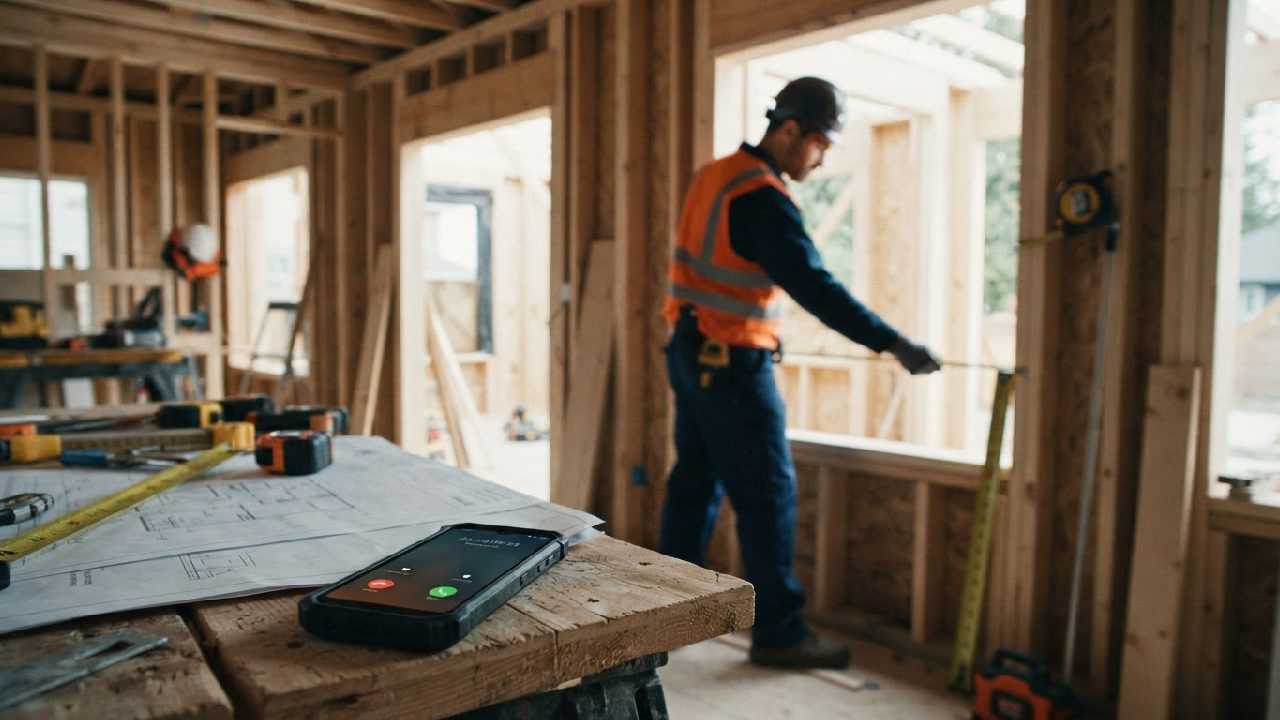
The homeowner calls during a noisy site visit. You cannot answer. They leave no message because they are unsure whether the job fits. By the time you see the missed call, you have no project details and no clear reason for the call.
Nothing here proves the homeowner would have hired you. But the contact process failed to give either party enough information to continue.
A simple page could have explained your relevant services, shown an appropriate project and offered a short inquiry form alongside the phone number.
The missing piece is a destination, not more attention
The root problem is fragmented information. Your reputation sits in reviews, your work appears in social posts and your availability lives in your head.
Homeowners must assemble those pieces themselves. Some will; others will move on.
Recommended framework: Proof → Fit → Contact → Ownership. This four-part check keeps the first website small and operationally useful:
- Proof: Can visitors see relevant work and access genuine reviews?
- Fit: Can they tell what you do and where you work?
- Contact: Is there an obvious way to ask about a project?
- Ownership: Does someone reliably handle that request?
The fourth part matters as much as the first three. A polished form connected to an unattended inbox is still a broken contact path.
The hidden cost is wasted qualification and uncertain work
The business cost is not just the possibility of a missed inquiry. It also appears in repeated explanations, unsuitable estimate requests and follow-up that happens from memory.
If homeowners cannot see your scope, you may spend evenings explaining that you do not offer handyman repairs. If contact information is incomplete, you spend time chasing a town, project description or callback number before deciding whether to schedule a conversation.
The revenue mechanism is straightforward: clearer fit can help suitable prospects proceed, while better intake can preserve the conversations you already attract. Neither guarantees a booked project.
Illustrative calculation: Five unnecessary ten-minute qualification calls consume fifty minutes. That is an administrative cost you can measure; it is not evidence of lost sales.
Do not value every missed call as a full contract. First establish whether it was a genuine project inquiry and whether the job matched your business.
More promotion cannot repair an unclear next step
Common fixes often increase activity without resolving the contact problem:
- More social posts: Useful for showing current work, but essential details remain scattered through a feed.
- More review requests: Helpful for reputation, but reviews cannot consistently explain your current service boundaries.
- Paid traffic: Sends more people into the same uncertainty if there is no useful destination.
- A large website build: May delay publishing the few details homeowners need now.
A one-page site is the recommended first move when your main need is credibility and basic project intake. Consider a larger site later if distinct services require separate explanations, your portfolio is extensive or visitors need detailed planning resources.
When evaluating an agency, ask who controls the domain, where inquiries go, how edits work and what happens if you leave. A low-friction launch should not create a long-term ownership problem.
Build one page that helps the right homeowner act
Show project fit before company history
Start with a plain statement of your main work and actual service area. Add one prominent action, such as “Tell us about your project,” with a click-to-call option nearby.
Illustrative wording: “Residential additions and interior remodeling in [your actual service area]. Tell us what you’re planning, and we’ll confirm whether it fits our work.” Replace the placeholder before publishing.
Avoid broad claims such as “We do everything.” Name the work you want and state important exclusions when they prevent unsuitable inquiries.
Use a small amount of relevant proof
Choose three genuine project photos you have permission to publish. Briefly describe your scope on each project rather than showing attractive rooms without context. Do not publish customer addresses or private details.
Link to your live review profile. If reproducing reviews, preserve their meaning, follow the platform’s applicable rules and obtain permission where needed. List licensing and insurance details only when accurate and current; check local advertising requirements.
Make the next step easy to complete
Keep the form short: name, preferred contact method, phone or email, project town and a brief description. Timing can be optional. Ask for a full street address later if it is needed.
Explain what happens after submission: an initial fit conversation, not an automatic estimate appointment. State realistic response hours instead of suggesting someone is always available.
Use a readable mobile layout, clear field labels and a visible phone fallback. Include an appropriate privacy notice and do not quietly add inquiry contacts to marketing lists.
Launch only after a real-device check
Implementation checklist:
- The business controls the domain and has administrator access.
- Services, service area and contact details are accurate.
- Project photos are genuine, relevant and cleared for use.
- Review links open the correct profile.
- The phone link works on a mobile device.
- A test form reaches the responsible person and backup.
- The confirmation explains the next step and response hours.
- The page remains readable and usable on a phone.
Give every inquiry an owner, then measure the handoff

Separate acknowledgment from a human answer
Automation performs predefined tasks, such as confirming receipt or notifying the office. Human handoff means a named person takes responsibility for reading the request, checking fit and responding. Escalation means involving a backup or qualified decision-maker when the usual process cannot safely or reliably handle it.
For a small contractor, begin with a form notification and one assigned responder. Use a shared inbox if more than one person handles inquiries. You do not need a chatbot or complex CRM to establish ownership.
An automated acknowledgment should say the request arrived, give accurate response expectations and explain that no appointment is booked yet. It should not quote prices, confirm availability or judge structural safety.
Set a response target your working day can support
A five-minute first-response target during staffed hours can be useful only if someone is available to meet it. It is an operational target, not a research statistic or a promise to resolve the project in five minutes. Measure automated acknowledgments separately from meaningful human replies.
If you work alone, publish a realistic response window and reserve specific callback periods. Assign a backup for absences where possible.
Escalate unattended inquiries when the stated response window is at risk. Route structural, permit and scope questions to the appropriate qualified person rather than letting an automated reply answer them. Make clear that a project form is not monitored for emergencies.
Compare useful conversations, not just visits
Record what you can before launch, then use the same definitions afterward. A simple spreadsheet can track source, project type, fit, first human response and next step. Keep personal information access-controlled.
| Measure | Before launch | After launch | What it helps you decide |
|---|---|---|---|
| Genuine project inquiries | Record calls and messages you can identify | Add website inquiries and remove duplicates | Whether contact volume changes |
| Fit information captured | Note missing scope and location | Check whether submissions contain both | Whether intake saves clarification work |
| First human response | Record when feasible | Compare within similar staffed hours | Whether ownership is working |
| Qualified inquiry share | Count suitable inquiries out of total | Apply the same fit criteria | Whether the page attracts relevant work |
| Next steps booked | Track fit calls or site visits | Use the same definition | Whether conversations progress |
Review patterns after a few weeks, but avoid conclusions from a handful of inquiries. Seasonality, referral activity and project mix can affect comparisons. Ask callers how they found you; do not attribute every new job to the website.
Fix the smallest missing step before buying more traffic
Key takeaways
- Reviews establish trust; your website should explain fit and the next step.
- One useful page is a practical starting point, not a guaranteed growth engine.
- A form needs an owner, a realistic response window and a backup path.
- Measure qualified conversations and follow-through, not visits alone.
Q: Is a business profile enough without a website?
A: It can generate calls, but it offers limited control over how you explain project fit and intake. A focused website gives referrals and profile visitors a consistent destination you control.
Q: Do I need automation before launching?
A: No. A working form, phone fallback and responsible responder are enough to begin. Add automation only for a defined task, such as confirming receipt or alerting a backup.
Q: Should I build the website myself or hire help?
A: Build it yourself if you can publish, test and maintain the essentials reliably. Hire help if ownership, mobile usability, setup or inquiry routing would otherwise remain unfinished.
Your next step: Request a Free 3-Second Audit. Start with this question: can a referred homeowner quickly understand your work, recognize project fit and find a clear way to contact you? Use that gap to prioritize your first page before committing to a larger marketing build.
Last reviewed: November 17, 2026.
Ready for the next move?
See exactly where your business is losing calls, and what it takes to fix it.
Free 3-Second Audit